PathFRAX reads the routine CT scans (e.g. CT chest, abdomen, and pelvis) your patients already receive, identifying the vertebrae most likely to fracture months before they do.
1
The Problem
84.6%
of high-risk patients are missed before their fracture2
The turning point
A metastatic vertebral fracture means pain, lost mobility, hospitalization, and a sharply higher risk of death.3
No standard of care
Risk is judged with subjective, unvalidated methods like the SINS score, so results vary from clinician to clinician.4
A missed window
Most high-risk patients miss the time to intervene with non-operative or minimally invasive preventative care.2
Case Example
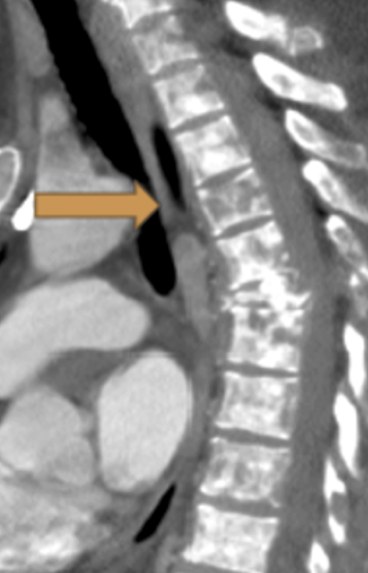
High-risk vertebra (T4)

Missed impending fracture
2 months later
Intervention window
The window to act was missed
Fracture
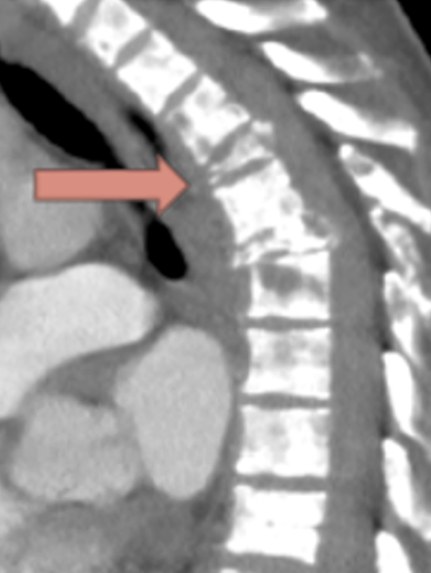
Without intervention
2
The Solution
Management of the metastatic spine continues to evolve toward early, preventative approaches.8 However, no significant advances have been made in identifying patients at risk for fractures who should undergo preventative interventions.9
PathFRAX is designed to address this gap by providing a repeatable, accurate metric of risk that is readily available to all providers on the cancer care team.

Results
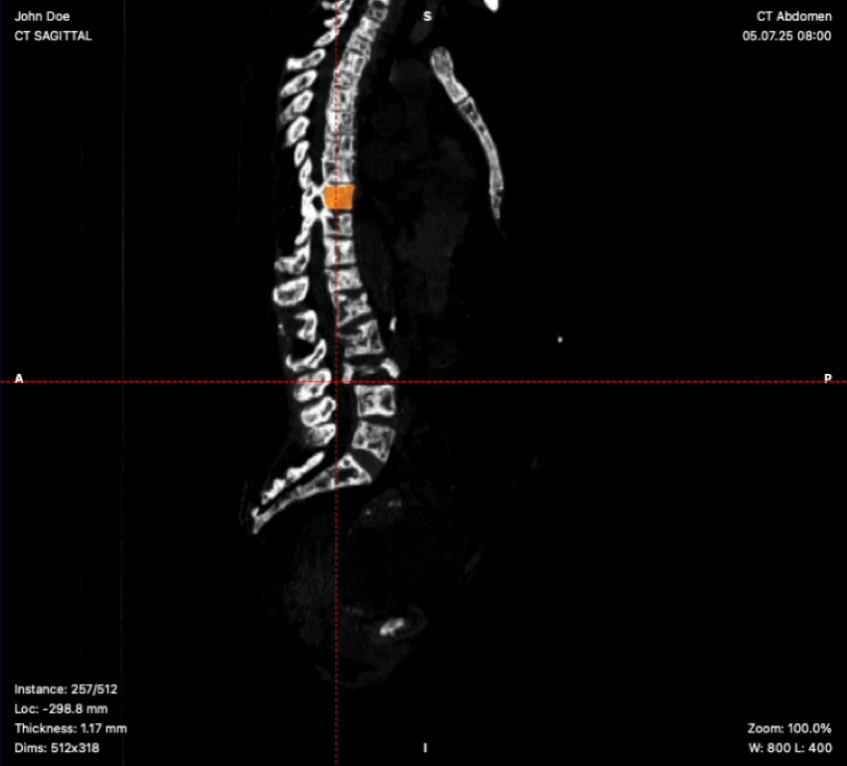
Vertebra is at high risk of fracture in 3 months.
Identifying missed patients
PathFRAX aims to capture the currently missed high-risk patients so interventions can take place before the fracture.
No new images
PathFRAX utilizes the CTs, such as CT chest/abdomen/pelvis, your patient already has and can be run on past or present images.
Enabling patient-specific, data-driven care decisions
PathFRAX aims to provide clinicians and patients with the data to create personalized care plans.
3
The Benefits
Patients
A solution that won’t let you go missed until it’s too late.
We aim to provide patients with early, objective risk stratification.
Physicians
A solution to inform your management.
We aim to give cancer providers early, objective data on fracture risk to inform consults, interventions, and patient discussions.
Payers
A solution to reduce cost.
We aim to reduce costs by reducing VCF incidence and high-cost inpatient stays and open surgical procedures.
Bring earlier, more certain fracture care to your patients.
Get in touch →References:
1. Schulman KL, et al. Cancer. 109(11):2334-2342 (2007).2. Flores AR, Hamre T, Tom M, et al. Poster presented at: Congress of Neurological Surgeons (CNS) Annual Meeting; October 11, 2025; Los Angeles, CA.3. Rees-Punia E, et al. JAMA Oncol. 9(1):79-87 (2023).4. Kim YR, et al. Sci Rep. 11(1):5553 (2021).5. McClelland S 3rd, et al. Rep Pract Oncol Radiother. 28(3):379-388 (2023).6. Van den Brande R, et al. J Bone Oncol. 35:100446 (2022).7. Hamre T, Flores AR, Tom M, et al. Podium presentation at: North American Spine Society (NASS) Annual Meeting; October 2026; San Antonio, TX.8. Glicksman RM, et al. JAMA Oncol. 6(4):567-577 (2020).9. Lee CH, et al. J Korean Neurosurg Soc. 64(1):4-12 (2021).